
Forecasting Fire's Future
The story of a paper about assessing climate change impacts on landscape fire

A mere three posts into the existence of this humble blog I had already waded into the steaming waters of soothsaying. How can we know the future? I presented an insightful harrowing whimsical assessment of the seemingly limited number of ways we might figure out what is about to smack us in the face as we sprint blindly around the corner of time. The post was so short that I can pretty much excerpt the whole dang thing here (but do visit the original for a reproduction of John William Waterhouses’s cool painting, The Crystal Ball).
Option #1 You know the future already
If you have the power of divination this is definitely a good option. Please leave next week’s Lotto numbers in the comments section.
Option #2 Make something up
This isn’t so bad. You might get it right! Even if you don’t, people might not notice, or remember, or have the power to do anything about it (remind you of any government forecasts?). For added robustness make your predictions vague and open to interpretation (here’s looking at you, Nostradamus).
Option #3 Tomorrow = today (a.k.a. inertia, status quo)
Now we’re cooking. Assuming that the future will look like the present can be surprisingly solid. It can get complicated quickly though. What if you’re not even sure what today looks like? What if things keep changing, and so to be safe you also look at yesterday, and the day before, and… how far back do you go? Option #3 would have been a super embarrassing guide the day before the big bang.
Option #4 Model it
Ding ding ding! Whether your model is simple, complex or inscrutable (hey, don’t knock machine learning), you are at least taking prediction seriously now. Bonus points for a) making your predictions specific, falsifiable and publicly available, and b) being open to revising your model.
Option #5 Control it
This can drastically reduce prediction error but the record of successful attempts to control the future is patchy. Those who do seek to partially or fully control something generally need some kind of model to guide their interventions anyway, which sends us back to Option 4 above.
Perhaps eerily, the blog post included the word ‘gazing’ in it. Fast forward three years, two months and two days, and lo and behold we published a paper titled
Gazing into the flames: A guide to assessing the impacts of climate change on landscape fire
You can read it for free here: https://doi.org/10.1126/sciadv.adz2429
I wrote it with Mike Flannigan, Francesca di Giuseppe, Lynn Johnston, Jennifer Marlon, Trent Penman, Andy Pitman and Guido van der Werf.
In some ways, the paper represents the culmination of everything I’ve learned about climate change and fire since I started my PhD back in 2010. Should we be concerned that all this ‘knowledge’ fits in 16 pages (11 and a half if we don’t count references)? Hey, the font size is small.
In the spirit of all self-help books, what looks like a collection of hard-won insights and essential tips for researchers, fire managers and policy makers is actually a letter to myself, asking me to pull together my many disordered thoughts into a structure that hangs together long enough for me to remember and act on it.
Twin Pillars
One of the key contributions of the paper, in my view, is our attempt to bring together the worlds of fire research and climate change impact assessment. I got some pushback from reviewers (and some co-authors!) on this point, who felt that our excursion into the finer points of climate system modelling took us too far from the topic of fire. I responded obstinately that this was the point - too often these things are done from one camp or another. Uncharitably, fire people waded into climate without really getting it or climate people waded into fire without really getting it. I hasten to add I’ve worked in both for a while and I still don’t get either, so I am not coming from a position of authority! But still, it felt worthwhile to me to try, as much as possible, to engage with each on its own terms rather than through the lens of the other.
Three Faces
We ended up dividing the fire content into three sections: fire itself, the drivers of fire and the impacts of fire. Looking at things this way drove home for me that future fire research has tended to focus on fairly narrow measures of fire (e.g. area burnt), a limited subset of drivers (e.g. weather) and not much at all on impacts. There are good reasons for this, and us authors fess up that we are also guilty of these things!
Mind The Thorns
One of the more fun parts of the paper to write was a list of ‘thorny issues’ in the fire and climate projection sections. The aim was to identify and point to important issues that were not always addressed (and indeed that we don’t always know how to address). I can’t remember who first called them thorny issues, but my assumption was we would find something more serious and accurate as we got closer to a final draft. That never happened. Here’s a couple of excerpts
Thorny issues in climate change impact assessment - Model evaluation
There is no consensus on what makes a “good” or “bad” model despite major assessment processes led by the IPCC. A major challenge for end users of ESMs [earth system models] is the rapid increase in the variety of models. In 1990, when the first IPCC report was published, three coupled climate models existed - now, there are 61. While more models might seem beneficial, these models are not fully independent, potentially biasing results when multiple seemingly independent models are averaged or otherwise combined. Despite this, there are no standardised methods or best practices for bias correction and different methods can lead to very different outcomes.
Thorny issues in projecting climate change impacts on landscape fire - Baselines
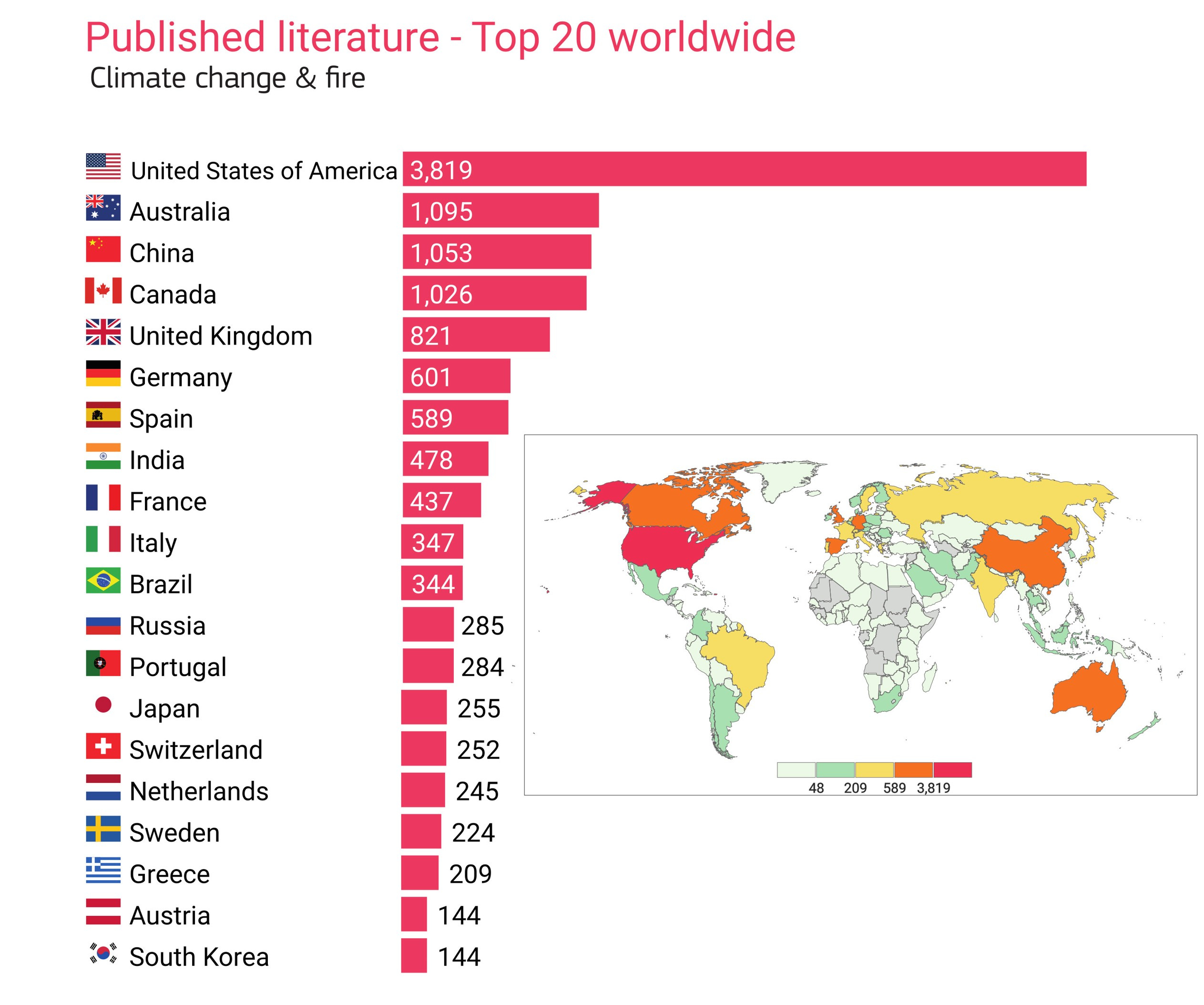
Climate change impacts depend on properties of the prevailing fire regime, including the relative importance of fuel, dryness, weather, and ignition; the interplay of these factors and how they constrain fire is complex and varies spatially. This limits our understanding of current baselines and thus our ability to interpret potential changes. Furthermore, much of our knowledge of fire and its interactions with the weather/climate system is biased towards studies whose authors were based in North America, Australia and Western Europe. These blind spots can be locally, regionally and even globally important (c.f. the tropics).
Go Figure
Francesca di Giuseppe prepared some beautiful figures for the paper, once more underlining the message that the message ain’t enough - it’s how you say it. Here’s one of ‘em, which we referenced in the passage above about the bias in location of many climate change and fire studies.
I also produced a powerpoint horrendogram (which I’ll spare you - seek it out at your own risk), something I have somehow felt compelled to do in multiple recent papers. To paraphrase Alain de Botton, grief is the only rational response to the news that an academic has invested considerable time devising a powerpoint concept figure.
The Meaning Of It All
A great little bonus at the end of the project was me asking the authors what they thought the key message of the paper was. Not everyone responded, but I just loved how even the people on a paper can’t agree on what it means! (If any of the other authors are reading this and want to add their take, please do so in the comments)
Here’s Andy
We know lots about landscape fires but that knowledge is silo’d in groups with deep expertise focused on management, risk, climate change, mitigation strategies and so on. Australia has the pieces of the jigsaw well developed, but has little appetite to build the multidisciplinary team that bridges the range of sectors, knowledge systems and Indigenous knowledge required to manage fire. Australia responds well to a fire, and we rightly celebrate Emergency Services, but until we build the multidisciplinary teams needed, strategies will continue to be responsive, not proactive and in a changing climate that puts Australian lives at risk.
Here’s Lynn
There are many tools and approaches available. We must use them effectively and creatively, and understand their limitations (the “thorny issues” tangled within them) to produce the best available predictions. The next steps of producing “better” predictions by improving models and making new approaches is NOT the most crucial thing that must be done (though improvement and innovation are still important of course). Decades of work on assessing climate change impacts have made it abundantly clear that assessment alone does not necessarily lead to concrete, meaningful steps to mitigate or adapt to these impacts. Moving forward, translating knowledge into action is the key.
And here’s Francesca
One of the main strengths of the paper, in my view, is that it finally bridges the gap between climate change and fire. For decades, the climate science community has devoted monumental effort to demonstrating that climate change is real. A battle that has correctly focused on a single, simple narrative: temperature is rising. This has been essential, but it is now only the starting point.
The real challenge ahead is to understand how these changes translate into the practical realities of everyday life and into the dynamics of complex hazards like wildfire. The methods that worked for temperature cannot be applied straightforwardly to variables that GCMs [global climate models] do not represent at all.
This is where the paper makes a major leap. It explains the conceptual and methodological transition from attributing changes in a well-simulated variable (temperature) to understanding changes in landscape flammability or even burned area, which are not explicitly modelled in climate simulations. Articulating what you should consider to make this jump scientifically is, I believe, one of its key contributions.
And that was me.