
Breaking: Anthropologist Reads Fire Book, Has To Tell You About It
Guest post by Timothy Neale

On January 9, the entire state of Victoria seemed alight. The Vic Emergency site was absolutely littered with emergency icons and coloured polygons. My wife and I nervously plotted a route back from the not-yet-on-fire Blue Mountains to our newish home in Melbourne. When all was said and done, around 400,000 hectares burned (not all equally severely, mind). A poor soul perished, hundreds of homes and structures were burnt, as were thousands of livestock and countless other denizens of the tree of life. The impacts on people, homes, communities, cultures, ecosystems, waterways, airways, industries (and institutions and politics…) are ramifying as we speak.
It’s times like these I feel particularly useless. But it’s much easier to find space for the role of research when I turn to colleagues whose work I admire, whose ideas and words I believe are making a difference, albeit in the usual, nonlinear, unpredictable ways. It thus brings me almost unbearable delight to hand you over to Future Fire’s first ever guest blog post. And let this be a warning to you, other colleagues and friends - I’m coming for you.
Take it away, Tim!
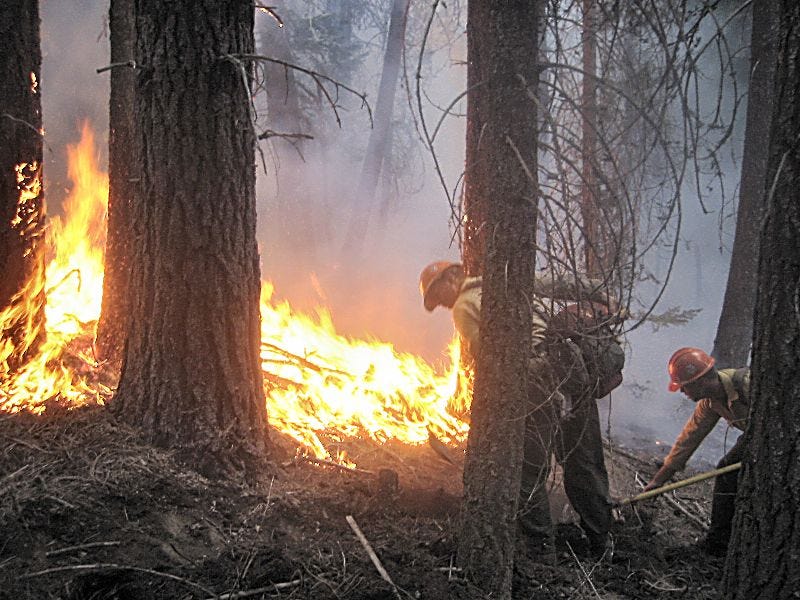
I’m an anthropologist who studies fire management (amongst a few other things), and let me tell you something for free: despite fire management being a multibillion dollar sector in Australia and several other countries like the US and Canada, we know relatively little about the sector’s workforce or how it functions as a social world. While the fire-industrial-research complex can sometimes feel like a pretty enormous region of scholarship – largely dominated by the “hard” sciences – and the social science suburb or hinterland is decently sized (and reasonably well-populated) there are not that many of us who devote our work to studying the many institutions and people who actually “do” fire management.
So, when Jordan Thomas managed to publish an ethnography of fire management in California, I stood up and took notice. Or, more accurately, I bought a copy of the book. In terms of other book-length ethnographies of fire management practice, the library to date is only really Desmond’s excellent On the Fireline (2007). We get tours in other great books like Petryna’s Horizon Work, Eriksen’s Gender and Wildfire, and Pyne’s plantation of prose (plus, ahem, my own contribution coming to good bookstores in 2026), and there is a growing literature of articles by anthropologists and others that take us to the firelines, control centres and offices where fire management is planned and implemented, thinking of research by folks like Jon Rasmus Nyquist, Colin Sutherland, and Arielle Milkman (amongst others). Then, alternately, there’s of course the wealth of autobiographical and biographical accounts of particularly famous firefighters (a North American genre mostly).
Which is all to say, it’s a big deal (to me) when a book like Thomas’s comes out. A PhD student at UC Santa Barbara, Thomas spent years studying fire management in the western US using a method known as “participant observation.” This is where you study a given community by actively taking part in its functioning (the participant bit) and analysing what you witness of its internal dynamics (the observation bit). Included in this fieldwork, crucially, was a six-month stint as part of a hotshot crew - a type of US Forest Service frontline firefighter that the book’s jacket and text variously describe as “the special forces” of US firefighting, “the Navy SEALs of wildland firefighters,” or “the most skilled firefighters globally.” I’m not here to judge these kinds of descriptions but you get the picture: it’s a high stress and high risk work environment.
Across the book, Thomas manages to not only take us along with the Los Padres Hotshots to a number of extreme “megafires” (a term he does not define), but also provides critical analysis informed by anthropological and sociological theory to understand what he encounters at a deeper level. Thomas is particularly adept at locating the diverse histories of landscape change, colonialism, Indigenous dispossession and climate change that have led to the current increase in frequency, intensity, size and impact of fires in America’s west. As he writes, “megafires emerge from a series of fractured relationships—between fire, the land, our institutions, and one another.” They have also, as he notes, produced a burgeoning economy of technofixes and supply contracts where “the bigger the fires get, the more money [some] make.”
He is unflinching in his descriptions of the hypermasculine and bullying behaviour that occurs on these firelines, while remaining careful to try and understand its productive role in sustaining these crews under extreme duress. Such firefighters can, he notes, get trapped “in a bind of cultural momentum,” where they must “learn to embody the very traits that could kill us” in order to get by. At camp, on a backburning operation, heading out to a wildfire on a rickety bus, these firefighters experience a constrained social world in which they must protect their reputation against accusations of physical and mental “softness” from “rival” crews, their own crew leaders, or fellow firefighters jostling for position and rank. Consequently, as Thomas experiences, these same colleagues come to feel a deep sense of love and gratitude towards one another, producing a sense of “a family I had not had before.”
But to get back to where I started, one of the core contributions of this book is to draw attention to the working conditions and labour structure of the firefighting sector in the US right now. As Thomas notes, since the 1990s, as wildfire hazards have grown, so too have the budgets of fire management agencies. To draw on a little bit of my own unpublished research, the budget of California’s state wildfire agency has grown tenfold since the 1990s, reaching approximately US$4 billion in 2024-2025, and the US federal budgetary impact of wildfire management rose from a yearly average of US$450 million in the 1990s to a touch over US$6 billion in 2025 (trust me that the growth is similar in Australia). Through this same period, many US jurisdictions have taken up greater use of incarcerated people as firefighters, as well as greater use of contract labour, both of which (it doesn’t take a political economist to tell you) are generally cheaper and more exploitable.
As Pro Publica reported last year, nearly half of the USFS’s permanent fire employees quit between 2021 and 2024 due to the poor workplace protections and pay, only to be partially replaced with inexperienced individuals willing to accept less secure contracts and pay equivalent to fast-food service. Reading Thomas’s account takes you to the lived reality of this in a uniquely ethnographic way. In one particularly affecting scene, towards the end of the book, a hotshot crew leader (a permanent employee) calls his crew into his office to fire them, one at a time. They have each just spent six gruelling months sweating and working to exhaustion for him, but if he fires them then they are eligible for unemployment benefits that they would otherwise miss out on. It’s an act of kindness since they’re not getting affordable healthcare or other workplace protections either way. Elsewhere, Thomas tells of the owner of a mansion trying to give the crew $100 bills for saving his house, before one firefighter advises them to keep the cash but pay their taxes.
It is these elements of the book that have kept rattling around my brain, following Thomas’ critical reflections on how inequality and class are shaping the matter of who makes a living and dying on the fireline now. Popular culture has fed us images of firefighting as a form of heroic sacrifice to the point that we can forget it’s also labour. As we learn more about the physical and mental toll of one’s workplace being wildfires - heightened risk of certain cancers, heart disease, and post-traumatic stress - we need to pay attention to how these workforces are being restructured under other pressures, such as social inequality, privatisation, and austerity. And, following on from this, we need to reconsider our conventional strategies for fighting fires as they become more extreme more often. Thomas can lapse into grandiosity at times – describing a rakehoe line as “a dirt band that holds fire back from the world” – but as he notes, our ability to suppress fires is clearly limited. “No human force can stand in her way” if a fire gets established under extreme weather, Thomas writes, “But this was precisely the job of the hotshots.” So, what are we doing putting people in front of megafires?
There are a lot of other things to celebrate about this superb book. The writing is at once fluid and detailed. Its theoretical chops are impressive but lightly worn. You should read it! But I also have several gripes which it feels churlish to describe at length but worth briefly noting for anyone else who picks up a copy (and you should). The primary one is that the book is seemingly written from Planet California, as though fire management that happens in places like Australia, Europe, South America, Russia, or even Canada do not really exist or have any relevance. This is a book written for the US market, so I understand why it has fallen prey to a myopia that afflicts a lot of US scholarship, but the presentation of prescribed burning - for example - as though it were a new “solution” made me reach for a cigarette (I don’t smoke, nor should you).
Reading Thomas’ book, I am left with big questions about the future of the fireline. As fire risks have intensified, and the impacts of both their occurrence and suppression have escalated, what has happened to the workplace conditions of firefighters in Australia? How is the sector being restructured and reshaped by the pressures of climate change, political division, and economic instability? “When it all burns,” to recall Thomas’ title, who’s going to still be sweating it out on the fireline?
This is also a long and elaborate way of saying: if you are working in the bushfire sector interested in these issues, and perhaps interested in talking about your ideas and experiences, then feel free to get in touch. I am at the beginning of a new project and keen to start mapping a pathway to some answers about how these vital labour forces are changing as we enter a more flammable future.
Clearly Tim is your 'brother from another mother', given the similarity of writing style! Very much to the point and clearly written.
Thanks Tim (& Hamish), The 'soft' sciences have much to add to FM knowlege; The fire 'problem' is more social than physical or ecological. I'll have add your forthcoming book to my reading 'pile'. Mike W